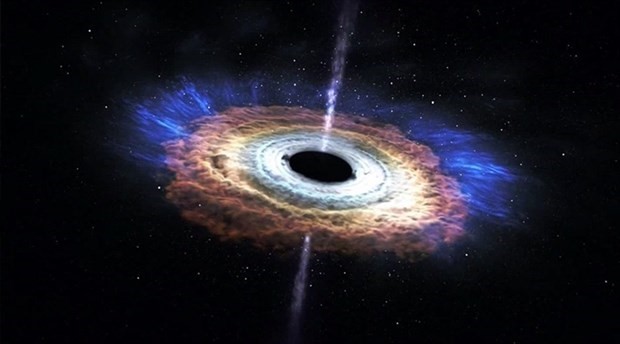
Black Holes: The Mysterious Gateways of the Universe


 Black holes are one of the most intriguing and complex phenomena in the universe. They are regions in space where gravity is so intense that not even light can escape. But how do black holes form, what types are there, and how do scientists study these enigmatic objects? In this article, we will delve into the nature of black holes and their impact on the cosmos.

How Do Black Holes Form?

The formation of black holes begins with the death of massive stars. When a star exhausts its nuclear fuel, it can no longer support its own gravity, leading to a collapse of its core. This catastrophic event, often ending in a supernova explosion, ejects the outer layers of the star into space. The remaining core, if massive enough, collapses further into a point of infinite density known as a singularity, creating a black hole. Thus, the birth of a black hole is essentially the end of a star’s life cycle.

Types of Black Holes

Scientists classify black holes into different categories based on their mass:

  1. Stellar Black Holes: These are formed from the collapse of massive stars, typically with a mass at least 10 times that of the Sun. They are scattered throughout the galaxy and are the most common type of black hole.

  2. Intermediate-Mass Black Holes: These black holes have masses ranging from hundreds to thousands of solar masses. They are relatively rare and are thought to form through the merging of several smaller black holes or the collapse of massive star clusters.

  3. Supermassive Black Holes: Found at the center of most galaxies, these black holes can have masses equivalent to billions of suns. The black hole at the center of the Milky Way, known as Sagittarius A*, is a well-known example of a supermassive black hole.

How Do Scientists Study Black Holes?

Since black holes do not emit light, they cannot be observed directly. However, scientists can infer their presence by studying the behavior of nearby stars and gas clouds. The gravitational effects of a black hole cause these objects to orbit at high speeds or get pulled into the black hole itself, creating high-energy emissions that can be detected by telescopes.

A significant breakthrough came in 2019 when the Event Horizon Telescope captured the first-ever image of a black hole located in the center of the M87 galaxy. This image provided visual evidence of the event horizon, the boundary beyond which nothing can escape, and marked a monumental achievement in the study of black holes.

The Mysteries of Black Holes

Black holes raise profound questions about the nature of space and time. What happens inside the event horizon? Is there a connection between black holes and other regions of the universe through phenomena like wormholes? These are just a few of the many questions that remain unanswered. Additionally, black holes play a crucial role in shaping galaxies and influencing the distribution of matter in the universe, making them a focal point of astrophysical research.

In conclusion, black holes are not just mysterious entities—they are gateways that deepen our understanding of the universe. As new discoveries are made, we will continue to unlock the secrets of these fascinating cosmic objects and gain a better understanding of the universe’s most enigmatic structures.

(This article is for informational purposes only and does not constitute professional advice.)

ChatGPT h
Black Holes: The Mysterious Gateways of the Universe Black Holes: The Mysterious Gateways of the Universe Reviewed by Havva Çetin on Ekim 05, 2024 Rating: 5

Hiç yorum yok:

Blogger tarafından desteklenmektedir.