
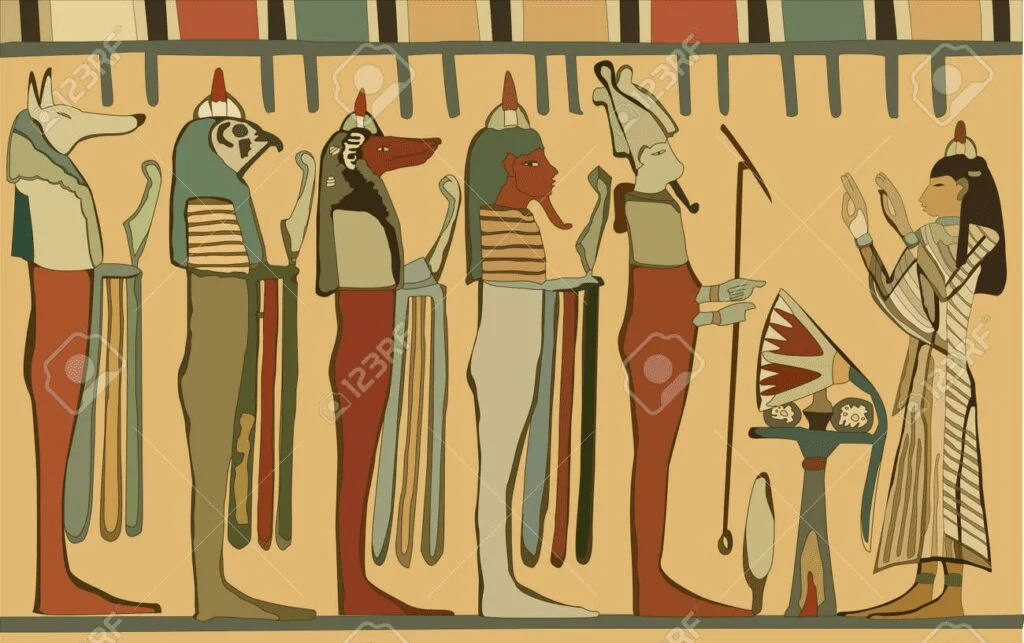
The Pantheon of Deities
At the heart of Egyptian mythology is a diverse pantheon of gods and goddesses, each representing various aspects of life, nature, and the universe. Some of the most significant deities include:
Ra: The sun god, often depicted with a falcon head, Ra was considered the king of the gods and the creator of all life. He traveled across the sky during the day and journeyed through the underworld at night.
Osiris: The god of the afterlife and resurrection, Osiris was associated with fertility and agriculture. His story centers around his death and rebirth, symbolizing the cyclical nature of life.
Isis: The wife of Osiris and the goddess of motherhood, magic, and fertility, Isis played a crucial role in the myth of Osiris. She was revered for her healing powers and her ability to protect the dead.
Horus: The falcon-headed god of the sky, Horus was the son of Osiris and Isis. He represented kingship and was often depicted as a protector of the pharaohs.
Anubis: The jackal-headed god associated with mummification and the afterlife, Anubis was believed to guide souls through the underworld and protect them during their journey.
Set: The god of chaos and storms, Set was often depicted as a figure of disorder. His rivalry with Osiris and Horus symbolizes the struggle between good and evil.
Creation Myths
Egyptian mythology includes several creation stories that explain the origin of the universe and the gods. One prominent creation myth involves the god Atum, who emerged from the chaotic waters of Nun at the beginning of time. Atum created himself and then produced the first gods, Shu (air) and Tefnut (moisture), who in turn gave birth to Geb (earth) and Nut (sky). This myth emphasizes the interconnectedness of the elements and the cyclical nature of creation.
The Afterlife: Beliefs and Practices
Central to Egyptian mythology is the belief in an afterlife, which significantly influenced their culture, art, and burial practices. Egyptians believed that the soul continued to exist after death, and the journey to the afterlife involved several stages, including judgment and resurrection.
Judgment of the Soul: Upon death, the soul was believed to be weighed against the feather of Ma'at, the goddess of truth and justice. If the soul was lighter than the feather, it was deemed worthy and allowed to enter the Field of Reeds, a paradise where the deceased could live eternally in peace. If heavier, it faced annihilation by the monster Ammit.
Mummification: To prepare for the afterlife, Egyptians practiced mummification, preserving the body to ensure the soul's survival. The process involved removing internal organs, drying the body, and wrapping it in linen. This practice reflected their belief in the importance of the physical body for the soul's journey.
Tombs and Offerings: Egyptians built elaborate tombs filled with offerings, including food, clothing, and treasures, to sustain the deceased in the afterlife. The construction of monumental structures like the pyramids demonstrated the significance of death and the afterlife in their society.
Symbols and Art
Egyptian mythology is rich with symbols and motifs that convey deeper meanings. Common symbols include:
The Ankh: Representing life and immortality, the ankh was often depicted in the hands of deities, symbolizing their power to grant life.
The Eye of Horus: A symbol of protection, royal power, and good health, the Eye of Horus was believed to ward off evil and ensure safe passage to the afterlife.
Scarab Beetle: Symbolizing rebirth and transformation, the scarab beetle was associated with the sun god Ra and the cycle of life.
Legacy of Egyptian Mythology
The influence of Egyptian mythology extends beyond ancient times, leaving a lasting legacy on art, literature, and religious practices throughout history. Many concepts from Egyptian mythology have permeated popular culture, appearing in literature, films, and modern spiritual practices.
Moreover, the fascination with Egyptian mythology has led to extensive archaeological studies, contributing to our understanding of ancient civilizations. The discovery of tombs, temples, and hieroglyphs has unveiled the complexity of their beliefs and the significance of their myths in shaping their worldview.
Conclusion
Egyptian mythology offers a profound exploration of the ancient Egyptian civilization's beliefs about creation, life, and the afterlife. Through its rich pantheon of gods and intricate myths, it reveals the values and aspirations of a culture that revered nature, celebrated life, and prepared meticulously for what lay beyond death. Understanding these myths not only deepens our appreciation for ancient Egypt but also reflects universal themes of existence, spirituality, and the quest for meaning that resonate across cultures and time.
(This article is for informational purposes only and does not constitute professional advice.)
Hiç yorum yok: